
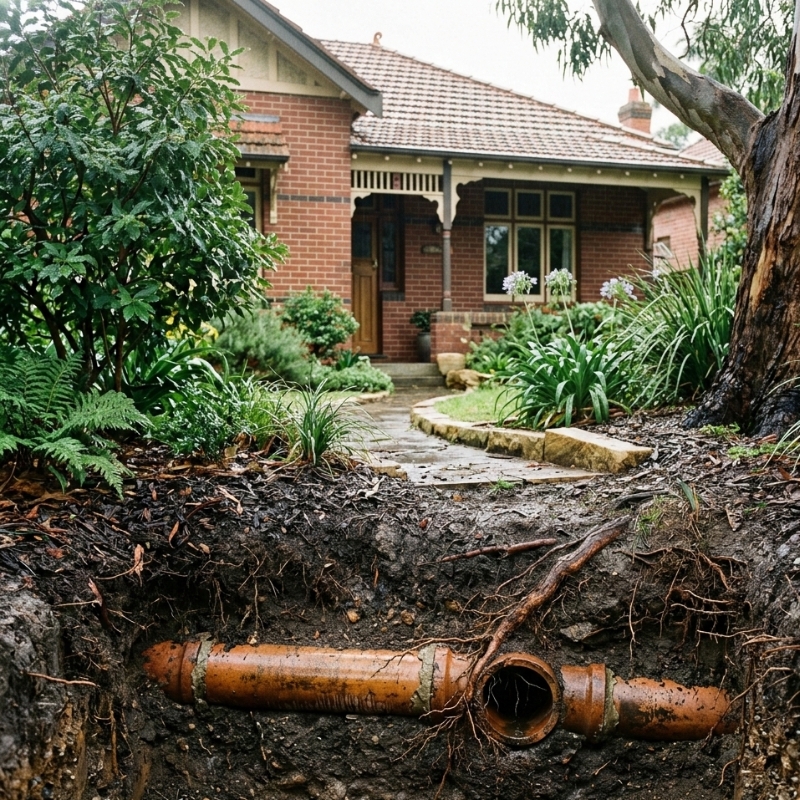
If you’ve noticed the same symptoms returning every few months (slow fixtures, gurgling, odours, an outside overflow after heavy rain), it’s not always about what went down the sink last night. In older properties, the way the pipes were originally set out, joined, repaired, and extended over decades can quietly set the stage for recurring drainage issues.
This guide breaks down the most common older-home plumbing layouts seen around Sydney, how they lead to repeat problems, and the early warning signs that suggest the issue is structural or layout-related rather than a one-off clog.
Why “layout” matters more than people realise
When people think of plumbing problems, they picture a single blockage in a single pipe. Layout problems are different. They’re patterns built into the system:
• More joints and connection points (more places for movement, cracking, and root entry)
• Pipe falls that are too flat (or have “bellies” where water and solids settle)
• Old materials that become brittle over time
• Add-ons and renovations that created awkward connections
• Shared or partially shared runs, especially in older terraces and subdivided lots
The outcome is predictable: a pipe can work “well enough” day to day, then tip into trouble whenever conditions line up—after a downpour, during heavy household use, or when roots hit a weak spot.
Common older-home layouts in Sydney that trigger repeat issues
Sydney’s older housing stock spans a big range, but many homes share similar underground drainage features. Here are the most common “repeat-problem” layouts.
1) Terracotta or clay pipe runs with lots of joints
Many older Sydney homes were built with terracotta/clay sewer and stormwater pipes. These pipes can last a long time, but the weak points are often the joints—especially after decades of ground movement, nearby tree growth, or repeated minor shifts.
Why does this lead to recurring issues?
• Tiny gaps at joints can let fine roots enter
• Small misalignments create ledges where paper/solids catch
• Cracks can let soil or debris intrude
• repeated wet/dry cycles and soil changes worsen the gaps
This is one reason older suburbs with established trees can see repeat symptoms: roots aren’t always “breaking” good pipes—they’re exploiting existing weaknesses.
2) Mixed-material “patchwork” plumbing from renovations
Older homes in Sydney are renovated constantly: new bathrooms, added laundries, granny flats, kitchen relocations, rear extensions. Over decades, it can create a patchwork of materials and joins:
• older terracotta/clay tied into PVC
• old galvanised or cast-iron sections feeding into newer pipework
• multiple reducers/adaptors and angled joins
Why does this lead to recurring issues?
• Transitions can create catch points where debris hangs up
• Some connectors deteriorate faster than others
• A slightly poor join can become the “repeat offender” point in the system
• different materials move differently with temperature and ground conditions
If your symptoms started after a renovation (even years later), this mixed-material join is worth considering.
3) Long shared runs (common in terraces and tight lots)
In terrace rows and older subdivisions, the line from the house to the street connection can be longer than you expect, and sometimes runs in unusual places due to the property’s age and original planning.
Why does this lead to recurring issues:
• the longer the run, the more opportunities for sags, offsets, or intrusions
• repeated minor build-up has more distance to accumulate
• If multiple fixtures feed into a long run, the system is more sensitive to small restrictions
In tightly packed inner suburbs, older gardens also tend to have established root systems that follow moisture sources. If a long run crosses near trees, it’s a classic recipe for repeating symptoms.
Q&A: Why do problems seem worse in winter and during heavy rain?
During wet weather, soils change and groundwater rises, which can stress older joints. Heavy rain can also overload drainage systems in some circumstances, and Sydney Water notes that stormwater can contribute to wastewater network problems during heavy rain events. You can read their guidance here: Sydney Water’s wastewater blockages information.
4) Flat grades and “bellies” (sagging sections)
Older pipe trenches weren’t always built with modern compaction standards, and over time, the ground can settle. Even a small sag in the pipe creates a “belly” where water pools.
Why does this lead to recurring issues:
• solids settle in the low point instead of travelling through
• grease and fine debris cling and gradually narrow the flow path
• symptoms can be intermittent—fine one week, slow the next
• after heavy use (laundry day, guests staying), it suddenly shows up
This is one of the trickiest issues because a belly doesn’t always create a total stoppage—it creates a repeat slowdown that keeps coming back.
5) Gully trap positioning that masks early warning signs
Many Sydney homes have an outside gully trap that acts like a relief point. That’s useful, but it can also “hide” the seriousness until it becomes obvious.
What happens:
• The system copes indoors, but pressure builds outside
• You might not notice anything until you get an odour or an overflow near the gully
• it can look like a sudden issue even though the restriction has been building for weeks
If you’re not sure what to watch for, it helps to familiarise yourself with common blocked drain warning signs so you can catch changes before they escalate.
6) Separate stormwater and sewer systems that interact in confusing ways
Modern homes are often easier to interpret: stormwater (roof and yard) is separate, and sewer/wastewater (toilets, sinks, showers) is separate. Older homes can be less straightforward—particularly when previous owners altered downpipes, connected yard pits, or upgraded part of the system without a full redesign.
Why does this lead to recurring “mystery” symptoms:
• Rain-triggered issues can look like a sewer problem
• sewer-triggered issues can appear outside near stormwater pits
• overflow points can confuse the diagnosis if the layout is non-standard
A practical rule of thumb:
• If symptoms happen mainly during rain or immediately after, stormwater capacity or drainage paths may be involved.
• If symptoms happen during everyday indoor use (toilet flushes, showers, washing machine), wastewater flow is more likely involved.
Early warning signs Sydney homeowners often miss
Here are subtle signs that often show up in older-home layout issues before a dramatic overflow happens.
1) The “two-fixture pattern”
If the shower slows down and the toilet gurgles when you run the vanity tap, it suggests the restriction is not just at the shower trap. It can indicate the line downstream is struggling to breathe or pass flow.
2) “It clears… then comes back”
If everything seems to improve for a while (especially after hot water, plunging, or DIY additives) but returns in the same way, that’s a strong hint that the cause is structural: roots at a joint, a sagging section, or a recurring catch point.
3) Outdoor smells before indoor symptoms
Older layouts can let gases or odours show up around outside points first—particularly near gully traps—before anything is obvious in the bathroom.
4) Slow drainage after laundry day
Washing machines can push a lot of water quickly. If issues flare up after laundry loads (or when guests stay), it can point to a borderline system: it functions at normal flow, but can’t handle peak volume due to a partial restriction or poor fall.
5) Rain makes “wastewater-like” odours appear
If odours or damp patches appear after heavy rain, don’t assume it’s always the roof drainage. In older areas, ground saturation plus weak joints can change how water and gases move around underground.
Q&A: Are tree roots always the main cause in older areas?
Roots are common, but they’re usually a symptom of a weakness (a joint gap, crack, or displaced section). If the pipe and joints were perfect, roots would have far less opportunity to enter. That’s why repeated issues often point to an underlying fault that roots exploit over time.
What you can check safely at home
You don’t need to dig up the yard to gather useful clues. A few simple observations can help you understand whether the problem is local (one fixture) or systemic (layout/underground run).
1) Identify whether it’s one fixture or the whole line
• Only one sink is slow? Could be local build-up.
• Multiple fixtures affected? More likely, the main line downstream is restricted.
2) Watch what happens when you run water in different places
Try this sequence:
• flush the toilet
• run the bathroom basin
• then run the shower for 30–60 seconds
If you hear gurgling, see water levels change, or notice slow draining across multiple points, it suggests the system is interacting (a downstream restriction or venting issue).
3) Check outside overflow points during peak use
If your home has a gully trap, take a quick look (safely) during heavy indoor water use. Early signs include:
• rising water level in the gully
• fresh odour around the opening
• dampness around the rim or surrounding soil
4) Consider what’s changed recently
Recurring issues sometimes coincide with:
• a new tree planted or a mature tree growth spurt
• landscaping changes (new retaining walls, major garden works)
• a renovation that added a fixture or moved a kitchen/bathroom
• heavier household loads (more people, more laundry)
These changes don’t “cause” problems by themselves, but they can push an older, borderline layout over the edge.
How does older Sydney soil and ground movement play into repeated problems
Sydney’s geology varies from suburb to suburb, but ground movement is a real factor in how older pipes behave over decades. Seasonal moisture changes can cause soils to expand and contract. Over long periods, that movement can:
• shift joints slightly out of alignment
• create tiny cracks
• change pipe fall by creating sags
• open pathways for fine roots
In practical terms, it explains why a home can be “fine for years” and then suddenly develop repeat symptoms—nothing dramatic happened overnight; the system slowly drifted into a vulnerable shape.
Q&A: Why does it sometimes affect the front bathroom but not the back one?
In many older homes, different fixture groups join the main line at different points and angles. If the restriction is downstream of the front bathroom connection but upstream of the back connection (or vice versa), symptoms can seem inconsistent. That’s why patterns (which fixtures react together) are so useful.
Prevention that actually helps in older homes
Prevention in older homes is less about “never putting anything down the sink” (though that matters) and more about reducing the conditions that make a vulnerable layout tip into trouble.
1) Be deliberate with fats, oils and grease
Grease doesn’t just “wash away”. It cools, clings, and gradually narrows the inside of pipes—especially in flatter sections. In older layouts with marginal pipe fall, this can accelerate repeat slow-down cycles.
Simple habits:
• Wipe greasy pans with a paper towel before washing
• Collect cooking oil in a container rather than pouring it into the sink
• Use hot water and detergent after greasy meals (not as a cure, but as good hygiene)
2) Know where big root systems are relative to the line
If you have large trees near the house-to-street run, assume roots will seek moisture. The goal is to reduce opportunities for entry:
• avoid planting water-hungry species near likely pipe runs
• keep an eye on symptoms during growth spurts and wet seasons
• treat repeat issues as a “find the weak point” problem, not just a “clear it again” problem
3) Don’t ignore “minor” recurring symptoms
A system that repeatedly slows is telling you something. If you keep resetting it without addressing the underlying weak point, it tends to progress:
• a small joint gap becomes a bigger offset
• root hairs become a mat
• A belly holds more sediment
• pressure events become more frequent
If you want a plain-English overview of options people use once the cause is confirmed, this page can help you understand typical blocked drains solutions for Sydney homes without guessing.
When it’s time to stop DIY and treat it as a system issue
Some situations are not “wait and see” scenarios, especially in older properties where overflows can cause damage quickly.
Treat these as strong escalation triggers:
• sewage smell inside the home
• any wastewater overflow on the property
• repeated gurgling across multiple fixtures
• water backing up in the shower when the toilet flushes
• the gully trap rising during normal household use
• neighbours experiencing similar symptoms at the same time (possible shared downstream issue)
If you’re trying to make sense of what you’re seeing and want a deeper explainer, you can learn more about blocked drains and the common symptom patterns that point to bigger-line issues.
Practical scenarios (older Sydney home edition)
Scenario 1: “Slow shower + toilet gurgle” in a terrace
Likely interpretation: downstream restriction affecting the bathroom group, or venting interaction made worse by partial restriction. If it returns repeatedly, consider layout factors like flat grades, long runs, or root entry at joints.
Scenario 2: “Outside smells first, then slowly sinks”
Likely interpretation: the outside relief point (often the gully) is showing early pressure build-up. The restriction may be developing beyond the fixture traps.
Scenario 3: “Only after heavy rain”
Likely interpretation: stormwater capacity issues, saturated ground affecting joints, or confusing legacy connections. Track whether it happens without rain during normal indoor use—if yes, wastewater restriction is still likely involved.
Scenario 4: “Fine for months, then suddenly terrible after guests”
Likely interpretation: borderline pipe fall or a belly that accumulates sediment until a high-flow event stirs it into a stoppage. This pattern is common when the layout is sensitive.
FAQ
How can I tell if my home has terracotta/clay pipes?
Older homes often have terracotta/clay runs underground, even if the visible indoor pipes look modern. Clues include the home’s age, past drainage history, and how frequently the same symptoms return. If you’ve had sections replaced before, you may also have mixed materials (terracotta tied into PVC), which can be a hotspot for repeat issues.
Why do multiple fixtures act up at the same time?
Because the restriction is usually downstream of where those fixtures join the main line, when the main line can’t pass flow properly, pressure and air displacement show up as slow drains, bubbling, or gurgling in nearby fixtures.
What does it mean if the toilet gurgles when the shower runs?
It often suggests interaction in the shared line: water flow is displacing air and revealing a restriction or venting imbalance. In older homes, this can be amplified by long runs, flat grades, and partially restricted sections.
Why does my gully trap overflow?
A gully trap is often an overflow/relief point. If it rises or overflows, it usually means the line downstream can’t pass the flow fast enough. This can be triggered by a developing restriction (roots, offsets, bellies) and can be more noticeable during high household use or wet conditions.
Do tree roots “break” pipes?
Roots commonly exploit existing cracks, gaps, or weak joints rather than smashing intact pipes. If there’s a pathway to moisture and nutrients, roots will take it—and over time, they can expand the opening and worsen flow.
Is it normal for older homes to have recurring drainage issues?
It’s common, but it’s not something you have to accept as “just how it is”. Recurrence usually points to a specific vulnerability: joints, fall, long runs, mixed-material connections, or ground movement effects. The key is identifying which vulnerability is present so you can stop the repeat cycle.