
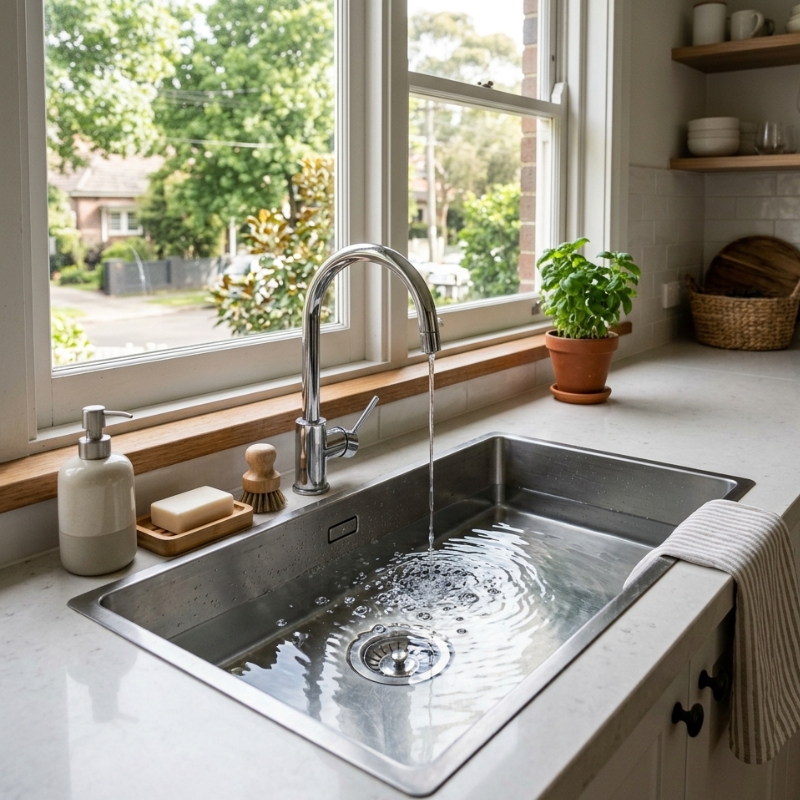
A gurgling sink is one of those household sounds that can feel minor at first — a quick “glug-glug” after you turn the tap off, a bubbling noise when the dishwasher drains, or a weird slurp that seems to come and go. In many Sydney homes, that sound is your plumbing giving you an early hint that a blocked drain may be starting to form somewhere in the system, or that something isn’t flowing (or “breathing”) the way it should.
Most of the time, gurgling is caused by one of two things:
• A restriction in the pipe (build-up or a partial obstruction)
• A pressure imbalance (venting isn’t letting enough air into the system)
You don’t need to panic, but you also don’t want to ignore it for months and hope it disappears. The best approach is calm, safe troubleshooting that helps you work out whether you’re dealing with a small local issue at the sink or a bigger drainage-system clue.
What the gurgling sound actually is
Your drains don’t just move water — they also manage air. When water rushes through a pipe, it needs air behind it to flow smoothly. If air can’t enter the system properly, the moving water can create suction (negative pressure). That suction can pull air through the water sitting in the trap (the U-shaped bend under your sink), causing bubbles and that characteristic “glug” or “gurgle”.
In other cases, a partial restriction narrows the pipe (think “pinched straw”). Water squeezes past the narrowed section, drags air with it, and releases it in bursts. The result can sound like bubbling, burping, or a hollow gurgle.
Q&A: Is gurgling ever “normal”?
A tiny bubble or quick glug once in a while can happen, especially with high-flow discharges like dishwashers. But if it’s frequent, getting louder, paired with slow draining, or you notice smells, it’s usually a sign the system isn’t operating as designed.
The two most common causes in Sydney homes
1) Build-up and partial restrictions (common in kitchens and vanities)
Sydney households often see gradual build-up from everyday use:
• Cooking grease and oils (that cool and harden inside pipes)
• Food scraps, coffee grounds, and starchy residue
• Soap scum and toothpaste film
• Hair and grooming products in bathroom basins
A pipe can be “not fully obstructed” but still restricted enough to create noisy, uneven flow — especially when a lot of water drains at once.
2) Venting and air-balance issues (common when multiple fixtures interact)
Plumbing venting (often via a vent stack that goes through the roof) helps equalise pressure. If venting is restricted, incorrectly configured, or struggling to keep up with demand, you can get suction that:
• Pulls water out of the trap (which can allow odours)
• Causes drains to gurgle when other fixtures run
• Makes the system feel “noisy” even if the drainage isn’t yet slow
In apartments and some terraces, shared stacks and complex layouts can make this show up as “my sink gurgles when someone else is using water”.
A quick sound-to-symptom guide
Use these patterns like clues. One clue might not be enough, but a few together usually point you in the right direction.
If it gurgles and drains slowly
Most likely: build-up or a partial restriction close to the sink, or further along the same branch line.
If it gurgles when the dishwasher drains
Most likely: a kitchen branch restriction (grease build-up is a frequent culprit) or a connection issue where the dishwasher hose ties into the sink waste.
If it gurgles when the washing machine runs
Most likely: the higher discharge volume is revealing a restriction or pressure imbalance in the shared line.
If it gurgles when the toilet flushes
Most likely: a bigger system interaction — venting, a developing issue further along the main line, or a shared line being stressed.
If it gurgles and smells at the same time
Most likely: the trap seal is being disturbed (siphoned) or there’s lingering wastewater in the line due to restricted flow.
Sydney-specific scenarios that make gurgling more likely
Sydney’s mix of older homes, renovations, and varied terrain creates repeat patterns.
Older suburbs with established trees
In areas with older pipework, roots can gradually find their way into joints or weak points. Even if the issue begins outside, indoor symptoms can start subtly — gurgling, slight slow draining, or a smell that comes and goes.
Heavy rain periods and drainage load
During wet spells, ground saturation and storm impacts can expose weak points. Sometimes people notice new drain noises after a stretch of rain because the overall drainage environment is under more pressure than usual.
Units and strata: shared stacks and timing clues
If you’re in a unit, look for patterns:
• Does it happen more at night or early morning?
• Does it happen when multiple neighbours are likely showering?
• Do other fixtures in your bathroom or laundry “answer back” with a burp?
Shared infrastructure can mean your sink is reacting to activity elsewhere — which is why paying attention to “what triggers it” matters.
Safe DIY steps you can try first
These steps are aimed at a single gurgling sink with no overflow. If you’re seeing water backing up, multiple fixtures acting up, or sewage-type smells, skip ahead to the red flags section.
Step 1: Check the obvious under the sink
Open the cupboard and look for:
• Drips or damp patches (slow leaks can cause odours and attract debris)
• Loose fittings
• A trap that looks knocked or misaligned (especially after storage changes)
If something’s been pushed against the pipework, reposition it so the trap and fittings sit naturally.
Step 2: Make sure the trap has water (especially guest bathrooms)
If a sink isn’t used often, trapped water can evaporate, letting smells up and sometimes contributing to odd sounds. Run the tap for 20–30 seconds, then listen again.
If smell improves but the gurgle remains frequent, you may still be dealing with venting or a restriction — but you’ve at least restored the water seal.
Step 3: Hot water flush for kitchen build-up (gentle, not extreme)
For kitchen sinks, a controlled hot-water flush can help soften greasy residue near the top of the line.
• Run hot tap water for a minute to warm the pipe
• Pour a steady stream of hot water (kettle water is hotter, but hot tap water is usually safer for older fittings)
• Repeat once or twice over a week, not ten times in one day
This won’t solve deeper issues, but it can reduce near-sink build-up that contributes to noise.
Step 4: Plunge properly (most people do it too gently)
A simple cup plunger can be effective for small restrictions.
• If you have a double kitchen sink, block the other drain with a wet cloth or plug
• Add enough water to cover the plunger lip and create a seal
• Plunge firmly 10–15 times
• Pause and listen: changes in sound can indicate movement
Stop if plunging causes water to rise in another fixture (like a nearby floor waste), because that can indicate a wider line issue.
Step 5: Clean the top of the waste (bathroom basins)
Bathroom basins often gurgle because the restriction is right at the top.
• Remove the stopper if possible
• Pull out visible hair/soap build-up (gloves help)
• Rinse, reassemble, then test the flow
It’s basic, but it can quickly remove the “mini plug” that causes bubbling.
Q&A: Should I use chemical drain cleaners for a gurgling sink?
Be careful. Some products are harsh on pipes, seals, and older fittings, and they don’t help if venting is the issue. If you use anything at all, follow the label exactly and never mix products. If the symptoms are recurring or affecting multiple fixtures, diagnosis beats repeated chemical use.
What to avoid (because it can make things worse)
Don’t keep “trying random fixes” for weeks
Repeated DIY attempts without a clear diagnosis can push debris into a tighter spot, or mask a developing issue until it becomes a messier one.
Don’t assume it’s only the sink
If your sink gurgles when the toilet flushes or the washing machine drains, the system is interacting. Treat it as a broader clue.
Don’t climb on the roof to “check the vent” if you’re not equipped
Roof access is a major fall risk, and venting issues aren’t always obvious from a quick look. If venting seems likely, it’s better handled as a proper diagnostic task.
Red flags that mean “stop DIY”
Here’s when a gurgling sink shifts from “worth monitoring” to “this needs proper attention”:
• The gurgle is getting louder, more frequent, or spreading to other drains
• Water drains, then rises again (a classic restriction clue)
• Multiple fixtures are noisy (kitchen, bathroom, laundry)
• Odours persist even after you’ve refilled the trap
• Any overflow at a floor waste, shower, or outside gully
• Plunging one fixture causes another to react
• The problem returns quickly after a temporary improvement
If you’re noticing any of the above, it helps to get familiar with the warning signs your drains are getting worse so you can act early and avoid a full backup.
How to tell blockage-style build-up from venting issues
This isn’t always perfectly clear without inspection, but you can make an informed call using patterns.
Clues that point more toward a restriction
• Gurgling + slow draining in that same sink
• The sink improves after plunging or cleaning the waste
• The noise is worse after heavy kitchen use (oily cooking, big washes)
• You see sediment or debris coming up after plunging
Clues that point more toward venting/pressure imbalance
• Gurgling happens mainly when other fixtures run
• Multiple drains “talk to each other” (one triggers another)
• Smells come and go, especially after high-volume discharges
• The sink drains reasonably well but is still noisy
Q&A: Why does my sink gurgle when the toilet flushes?
A toilet flush moves a large volume of water quickly. If there’s a restriction further along or the venting can’t balance the pressure, the system can pull air through nearby traps and drains. That’s why the sink can “glug” even when you didn’t use it.
What to do next if it keeps happening
If the gurgle is persistent, repeats weekly, or is linked to other fixtures, the smartest “next step” is usually to confirm what’s actually going on inside the line rather than guessing.
In practical terms, when the gurgling keeps coming back, it often helps to look into professional drain inspection options so you’re not relying on guesswork about what’s happening inside the pipe.
A proper inspection can help identify whether you’re dealing with:
• Grease build-up or compacted debris
• A partial obstruction further down the branch line
• A main-line issue affecting multiple fixtures
• Root intrusion or damaged sections in older lines
• Venting-related configuration issues
For Sydney homeowners, it’s also useful to know that official guidance exists around common causes of wastewater issues (like grease, unflushables, and roots). Sydney Water outlines typical causes and what to do if you suspect wastewater problems here: Sydney Water wastewater blockages.
Prevention that actually makes a difference (Sydney kitchen and bathroom habits)
If your sink gurgle is linked to gradual build-up, prevention is mostly about what you don’t send down the line.
Kitchen habits
- Wipe greasy pans with paper towel before washing
• Use a sink strainer and empty it into the bin
• Avoid tipping oils, sauces, and coffee grounds down the sink
• Run water a little longer after washing up to move residue along
Bathroom habits
- Clear hair from the basin and shower waste regularly
• Go easy on thick creams and heavy product build-up
• If a bathroom isn’t used much, run water weekly to keep traps primed
Laundry habits
- Be mindful of lint and residue (particularly if you’re washing pet bedding or heavily soiled items)
• If you’ve noticed gurgling during wash cycles, watch for any overflow at nearby floor wastes
When it’s a “repeat pattern” problem
A sink that gurgles once after a big weekend cook-up is one thing. A sink that gurgles every week, or whenever the dishwasher runs, is another.
Recurring symptoms can mean:
• The restriction is deeper than a quick clean can reach
• Multiple contributing factors are present (build-up + poor air balance)
• The issue is forming in a shared section of drainage (common in units)
And if this has become a repeat pattern in your home, it’s worth getting help with recurring drain problems before a minor nuisance turns into a messy interruption.
FAQ
Why does my sink gurgle after I turn the tap off?
When flow stops, the remaining water moving through the pipe can create a quick pressure change. If the line is restricted or air can’t balance properly, air gets pulled through the trap water, causing that final “glug”.
Why does my kitchen sink gurgle when the dishwasher drains?
Dishwashers discharge in a surge. If the kitchen branch line is narrowed by grease or debris, that surge can trap air and force it back through the sink waste as bubbles and gurgles.
My sink gurgles but drains fine. Should I worry?
It can still be an early sign of a pressure imbalance or developing build-up further along the line. If it’s occasional and there are no other symptoms, monitor it. If it’s frequent, getting louder, or paired with smells or cross-fixture triggers, treat it as a warning.
Why does the sink gurgle when the washing machine runs?
A washing machine dumps a high volume of water quickly. That can expose a restriction in a shared line or create pressure changes that make nearby fixtures gurgle, especially if venting isn’t balancing the system effectively.
What if I notice smells along with the gurgling?
Smells plus gurgling often point to the trap seal being disturbed (siphoning) or wastewater lingering due to restricted flow. If smells persist after you’ve refilled the trap and cleaned the waste, it’s a strong sign to stop guessing and get the cause confirmed.
Can plunging make things worse?
If the issue is minor and close to the sink, plunging can help. But if you notice water rising elsewhere (like a floor waste) when you plunge, stop — that can indicate a wider-line restriction where pushing and pulling pressure may cause messy movement in other areas.
What should I do if wastewater overflows outside?
Treat it as urgent. Follow Sydney Water’s guidance and report it appropriately, especially if the overflow is near public areas. Their wastewater blockage resource linked above is a good starting point for understanding typical causes and next steps.