
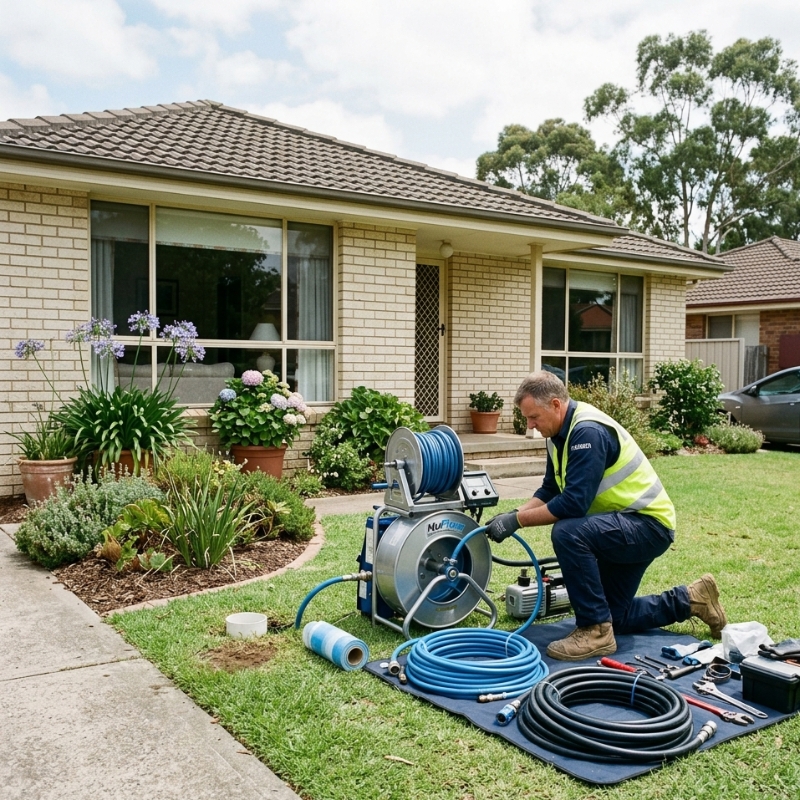
A slow-draining sink or a toilet that won’t flush properly can feel like a simple clog. And sometimes it is. But when the same problems keep coming back, or you start noticing changes outside (like soggy patches, bad smells, or ground movement), it may be more than “something stuck in the line” — and pipe relining could be part of the longer-term fix if there’s damage in the pipe itself.
This guide helps Sydney homeowners tell the difference between a straightforward blockage and symptoms that can suggest a collapsed (or structurally failing) drain pipe. It sticks to checks you can do safely, what to avoid, and the warning signs that mean it’s time to stop guessing.
First: what counts as a “simple blockage” vs a “collapsed pipe”?
A “simple blockage” usually means something has restricted flow inside the pipe but the pipe itself is still intact.
Common examples include:
• grease build-up and food waste in kitchen lines
• hair and soap scum in the bathroom wastes
• wipes, sanitary products, or too much toilet paper
• small tree roots catching debris at a joint
• a partial blockage in the main line that’s still passable
A “collapsed pipe” is different. It means the pipe has deformed, cracked badly, separated at a joint, or caved in, so the internal diameter is reduced (or completely closed). In older Sydney homes, this can happen with ageing clay/earthenware pipes, movement in reactive soils, heavy root intrusion, or a long-term leak that undermines the surrounding ground.
Quick answer
If only one fixture is slow and everything else is fine, it’s usually a local blockage. If multiple fixtures are affected, especially at the same time, or you have sewage smells, recurring backups, or changes in the yard (soggy patches or sinkholes), the odds shift toward a deeper issue in the main line or a damaged section.
The “pattern test”: the easiest way to sort symptoms
Before you touch anything, think about the pattern. The pattern often tells you more than the severity.
Patterns that usually point to a simple blockage
• One fixture is affected (e.g., only the shower)
• The issue builds slowly over weeks or months
• Plunging or hot water improves it (even temporarily)
• There’s no smell outside, no yard changes, no gurgling elsewhere
• The problem is worst right after that fixture is used
Patterns that raise suspicion of a collapse or structural failure
• Multiple fixtures are slow or backing up (especially lower fixtures first)
• Toilets gurgle when a sink drains, or drains “talk” to each other
• Recurring blockages return soon after DIY clearing
• Sewage smells show up inside or outside
• Water backs up at the lowest point (downstairs bathroom, floor waste, laundry)
• You notice soggy ground, unusually green patches, or subsidence near the line
• Blockages worsen after heavy rain (stormwater involvement can complicate symptoms)
Homeowner-safe checks you can do (without making things worse)
These checks are about observation and gentle testing, not forcing tools down pipes.
1) Work out if it’s one fixture or the whole house
Pick two or three fixtures in different areas (for example: kitchen sink, bathroom basin, toilet).
• If only one is slow: likely a local blockage near that fixture
• If all are slow or gurgling: likely a main line restriction or failure
• If the toilet is sluggish and the shower/bath backs up: often points to a deeper line issue
2) Identify the “lowest point” symptom
Gravity matters. The lowest drain in the home is often where backups show first.
Look for:
• floor wastes bubbling
• shower base filling when the toilet flushes
• laundry tub backing up when the washing machine drains
If the lowest point is affected, treat it as a bigger-line symptom, not just a small clog.
3) Smell check (inside and outside)
Do a quick, calm smell check around:
• bathroom floor waste
• laundry
• outdoor gully/inspection points (if you know where they are)
A simple clog can smell unpleasant, but a persistent sewer odour (especially outside near the route of the pipe) can be a clue that waste is escaping, sitting stagnant, or not flowing properly.
4) Listen for gurgling when another fixture drains
This is one of the most useful checks.
Try this:
• run the bathroom basin tap for 20–30 seconds
• listen at the shower drain and toilet
If you hear gurgling elsewhere, it suggests air is being displaced in a restricted system, which is more common when the main line is partially blocked, sagging, or compromised.
5) Yard check (only visual)
If you can, walk the likely path of your sewer line (often from the back of the house toward the street connection, but layouts vary).
Look for:
• a persistently soggy patch with no sprinkler explanation
• an unusually green strip of grass
• recurring puddles in dry weather
• small depressions or cracking in paving
• a “soft spot” you can see (do not dig)
These can suggest leakage or ground movement around a failing line. Not every soggy patch means collapse, but combined with indoor symptoms, it becomes significant.
6) Rain correlation: Does it get worse after storms?
Sydney downpours can overwhelm stormwater systems. If your issue spikes after heavy rain, it may involve:
• stormwater line blockage
• illegal cross-connections (rare but possible)
• saturated ground putting pressure on already-weakened pipes
• infiltration into damaged sewer lines
This pattern doesn’t prove collapse, but it’s a strong “investigate properly” signal.
Red flags: stop using water and treat it as urgent
If any of these happen, it’s time to stop running taps, dishwashers, washing machines, and repeated flushes:
• sewage backing up into showers, floor wastes, or the bath
• wastewater overflowing outside (gully/yard)
• a sudden, complete loss of drainage across multiple fixtures
• a noticeable sinkhole, rapid subsidence, or paving dropping
• strong sewer odour paired with wet ground
• water pooling near foundations
The risk isn’t just inconvenience. It can become a hygiene problem (sewage exposure), property damage, and in some cases a safety issue if the ground is undermined.
What NOT to do if you suspect collapse (or you’re not sure)
When people panic, they often do the exact things that make diagnosis harder and damage more likely.
Avoid:
• caustic drain cleaners (they can be dangerous, damage some materials, and won’t fix a structural failure)
• repeated aggressive plunging on multiple fixtures (can push waste into the system and trigger overflow)
• DIY drain snakes beyond a trap if you’re inexperienced (you can get the cable stuck, damage fittings, or puncture weakened sections)
• flushing repeatedly to “force it through”
• digging up the yard to “find the problem” (you can hit services, and it rarely solves the real issue)
If your situation is pointing beyond a simple clog, the best next step is confirming what’s happening inside the pipe.
What actually confirms “blocked vs collapsed”: CCTV drain inspection
A CCTV drain camera inspection is the quickest way to replace guesswork with evidence. It can show:
• a full collapse or a severe deformation
• cracks and fractures
• displaced joints or missing sections
• heavy root intrusion and where it’s entering
• a sag (“belly”) where water pools and solids settle
• foreign objects and build-up location
• whether the line is sewer or stormwater (depending on access points)
If you’ve got repeated issues, getting footage and a clear explanation of what you’re looking at is usually far more cost-effective than trying three different DIY solutions that only mask symptoms.
If the inspection shows damage that suits a trenchless fix, it helps to understand how pipe relining in Sydney works so you can make sense of what the footage is showing and what a practical next step might look like.
Collapsed pipe symptoms (in plain English) and what they often mean
Below are the common symptoms homeowners notice, and what they can indicate. None of these is a diagnosis on its own, but combinations matter.
Symptom: recurring blockages that return fast
If you clear a blockage and it returns within days or weeks, the line may have:
• a sag where waste collects
• roots that regrow quickly
• a broken joint catching debris
• a partial collapse creating a choke point
Symptom: Backups happen in the same place every time
When backups repeat at the same floor waste or shower, it often means:
• that drain is the lowest point (a “pressure release” for the system)
• the restriction is downstream of that point, in the main line
Symptom: gurgling toilets or drains
Gurgling is often trapped air moving through water because the flow is restricted. It’s especially telling when:
• it happens across multiple fixtures
• it happens during other fixture use
• it’s paired with slow drainage
Symptom: sewage smell inside or outside
Sewer odour can come from:
• dry traps (simple)
• venting issues (can be simple, but still needs assessment)
• stagnation behind a restriction
• leakage from cracked or separated pipes (more serious)
If it’s outside near the line route and persistent, take it seriously.
Symptom: soggy yard or unusually green patch
A leak can fertilise the soil and keep it wet. This can happen with:
• cracked sewer pipes
• displaced joints
• long-term seepage around a damaged section
Symptom: sinkholes or subsidence
This is one of the clearest “structural failure” signals. A void can form when water washes out soil around the pipe. Even a small depression can worsen quickly, especially after rain.
“Is it a blockage or collapse?” — a simple symptom stack you can use
Use this as a practical guide, not a medical-style score.
Likely simple blockage
• only one fixture was affected
• no gurgling elsewhere
• no smell outside
• no yard changes
• improves with gentle clearing steps
Needs investigation soon
• two or more fixtures are affected
• gurgling occurs
• recurring problems in the same locations
• slow drains across the home
• symptoms worsen after rain
Treat as urgent
• sewage backup or overflow
• sudden loss of drainage across multiple fixtures
• strong sewer smell plus wet ground
• visible subsidence or sinkhole signs
What happens if the collapse is outside your house line?
In Sydney, responsibility can depend on where the damage is located (private property vs public land). If a private sewer service collapses in public land (for example, under a footpath), Sydney Water may have a program that helps in certain circumstances.
If you want the official details, Sydney Water provides a customer guide for its collapsed private services in the public land program. It’s worth reading if your pipe route heads toward the street, and you suspect the problem is beyond your boundary: Sydney Water’s collapsed private services in public land guide.
If the pipe is damaged, what are the repair pathways (high level)?
This isn’t a quote guide — just the broad categories so you can understand what a plumber might recommend after inspection:
• Targeted clearing (if it’s truly a simple blockage)
• Repair of a localised break (if accessible)
• Replacement of a section (more invasive, excavation required)
• Trenchless rehabilitation, where suitable (for some cracks, joint issues, and certain damage types)
If the camera points to a repairable internal pathway, a trenchless pipe repair option may be worth discussing because it can address certain damage types without the disruption of full excavation.
Q&A checkpoints (the questions most homeowners ask mid-problem)
Can I tell for sure without a camera?
Not reliably. You can narrow it down using symptom patterns, but a camera inspection is what confirms whether the pipe is intact, cracked, sagging, root-invaded, or collapsed.
If water eventually drains, does that mean it’s not collapsed?
Not necessarily. A partial collapse or a sag can still allow slow flow. The giveaway is usually recurring blockages, widespread slow drainage, gurgling, and backups at the lowest point.
Do tree roots always mean the pipe is broken?
Roots typically enter through an existing weakness (joints, cracks, deteriorated materials). You can have heavy root intrusion without a full collapse, but it often indicates structural vulnerability.
Is it safe to use drain cleaner “just once”?
If you suspect a bigger issue, it’s usually not a good idea. Besides safety risks, chemicals don’t fix a structural fault and can complicate later work.
What should I do right now if sewage backs up?
Stop using water, keep kids and pets away, ventilate the area if indoors, and avoid contact. If it’s overflowing outside, keep clear and don’t try to “wash it away” into stormwater.
Final FAQ
What are the most common collapsed drain pipe symptoms?
Common signs include repeated blockages that return quickly, multiple fixtures draining slowly, gurgling toilets/drains, sewer odours, wet patches in the yard, and ground subsidence or sinkholes near the pipe route.
How do I know if it’s just a blocked drain?
If only one fixture is affected, there are no yard symptoms, no gurgling elsewhere, and the issue improves with gentle clearing, it’s more likely a local blockage close to that fixture.
Why does sewage back up into the shower?
The shower or floor waste is often the lowest point in the system. When the main line can’t move waste away fast enough, it backs up at the lowest opening.
Can heavy rain cause blocked drain symptoms?
Yes. Heavy rain can overload stormwater lines and saturated ground can worsen existing issues. If your symptoms spike after storms, it’s worth checking whether stormwater or a compromised sewer line is involved.
What’s the safest next step if I suspect pipe damage?
A CCTV drain inspection will confirm what’s actually happening in the line, and if the issue is structural, ask which repair pathway suits the location and pipe condition — including pipe relining for damaged drains where it’s appropriate.