
Tree Root Removal from Drains in Sydney
We cut tree roots out of Sydney drains and seal the opening they came through, which is a common reason a drain blocks more than once. Roots are cut out of the pipe, the opening they came through is found on camera, and the opening is sealed as part of the same job. Call any hour, or book online and we will quote before anything starts.
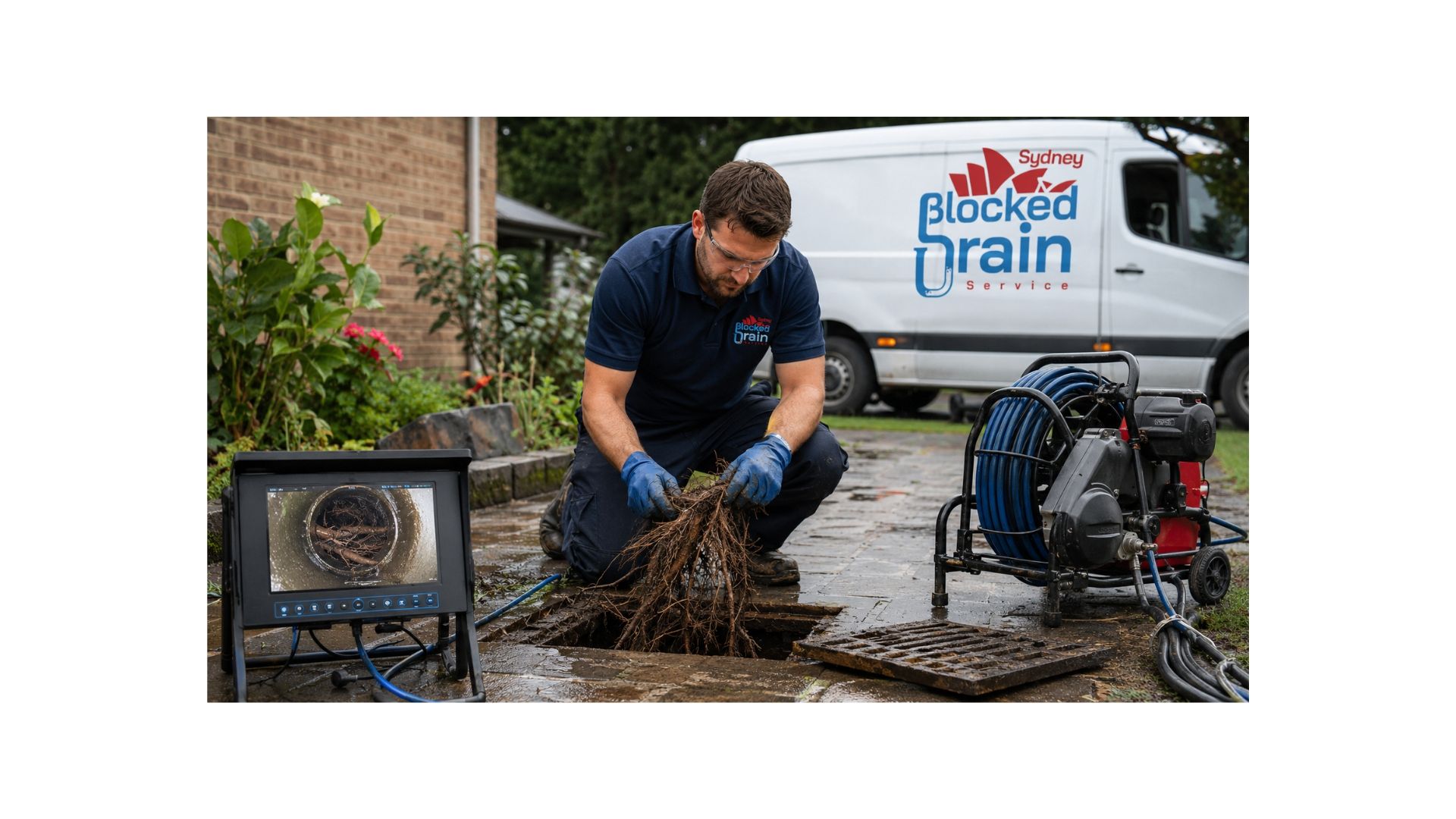
Roots removed from the drain, not the garden
Tree root removal in a drainage context means removing roots from inside a pipe and repairing the pipe they got in through. It does not mean removing the tree, grinding a stump, or excavating a root system in the garden. Those are arborist and landscaping jobs and we do not do them.
If your problem is a blocked or damaged drain with roots in it, this is the right page. If your problem is the tree itself, an arborist is who you want.
How roots get into a drain
Four stages, and understanding them is what explains why clearing alone never lasts.
Moisture is what attracts them
Roots do not seek out pipes. They follow moisture and nutrients, and a drain line leaking slightly at a joint produces exactly that. Once a root reaches the opening it keeps growing toward the source, which is inside the pipe.
Old joints give them the way in
Earthenware pipe was laid in short lengths, so there is a joint every metre or so. Ground movement opens those joints fractionally over decades, and a fractional gap is all a root hair needs.
Cracks from ground movement
Clay soils across much of Sydney shrink and swell with the seasons, which works on brittle pipe. A hairline crack is enough, and it widens as the root inside it thickens.
Then they thicken inside the pipe
What starts as a fine root becomes a mass that fills the bore and catches everything passing. The root also widens the crack it came through, which is why an untreated line gets worse each season rather than staying the same.
Signs it is roots rather than build-up
Roots behave differently from grease, and the pattern is usually enough to tell before anyone looks.
- The same drain blocks every few months, often worse after rain
- Gurgling from a drain when another fixture is used
- A line that clears easily and then fails again within weeks
- Slow drainage across several fixtures with no obvious cause
- Mature trees or large shrubs within a few metres of the drain line
What we do about roots in a drain
Four steps. Most providers stop at the first one, which is why the blockage comes back.
Cut the roots out
An electric eel drives a cutting head through the mass and shears it out of the pipe. Jetting afterwards clears the debris and cleans the wall so the camera has a clear view.
Find where they came in
The camera locates the joint or crack the roots entered through and records the position and depth. This is the part that decides whether the problem is solved or merely postponed.
Seal the opening
Relining the affected length forms a jointless pipe inside the old one, so there is no longer an opening for roots to find. Where a section has collapsed instead, replacement of that length is the answer.
Record the finished line
The camera runs through again afterwards so the repair is recorded. If you ever need to show a buyer or a strata committee what was done, that footage is what does it.
How the price works
There is no charge for coming out and looking at the problem.
Drain clearing starts at $69. What a job costs depends on the cause and where it sits.
You get the price before any work begins, and nothing goes ahead until you agree to it.
We take calls through the night, on weekends and on public holidays.
Tree root questions
Do you remove the tree?
No. This is drain work, not tree work. We clear the roots out of the pipe and repair the pipe so they cannot get back in. The tree stays where it is.
That is usually what people want anyway. Removing a mature tree is expensive, often needs council approval, and does not repair the pipe the roots already damaged.
Will the roots come back?
Into a pipe that has been cleared but not sealed, yes, and usually within a season or two. The roots were drawn to moisture escaping through a crack or an open joint, and cutting them out does not close it.
Into a relined section, no, because there is no longer a joint or crack for them to enter through. That is the difference between clearing a blockage and fixing the cause.
Can I just have the roots cut out every year?
You can, and for some properties it is a reasonable interim position, particularly where a repair is planned but not yet affordable. Scheduled cleaning does exactly this.
It is worth understanding what you are buying, though. Each cycle the crack widens a little and the root system behind it grows, so the interval tends to shorten over time rather than stay fixed.
Which trees cause the most trouble?
The usual pattern is fast-growing species with vigorous surface roots planted close to a drain line, and large established trees whose root spread simply reaches further than people expect.
The distance matters less than whether there is moisture escaping from the line. A sound pipe near a large tree is generally left alone. A leaking joint thirty metres away will still be found.
How do I know it is roots and not something else?
On camera it is unmistakable: roots look like roots. From the fixture it is not, which is why a repeating blockage is worth a camera inspection rather than a third clear.
The strongest clue before anyone looks is timing. Grease and build-up get gradually worse. Roots produce a blockage that clears well, behaves for a while, then returns.
Related drain services
Book a tree root removal
That pattern is roots until the camera proves otherwise. We will cut them out and show you where they got in, so you can decide whether to seal the line or keep clearing it.
NSW Licence 306733C. Fully insured. $0 call-out fee. Blocked drains cleared from $69.